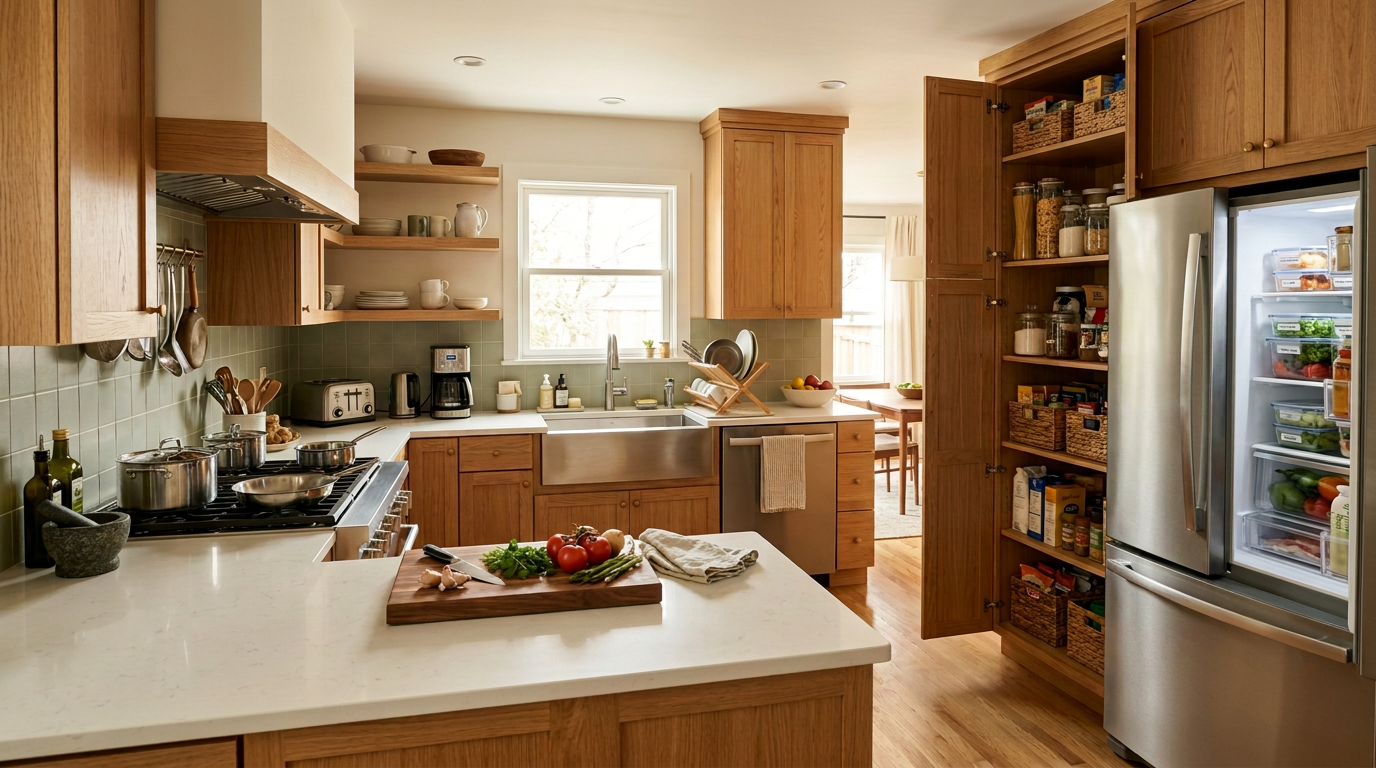
A kitchen can be easy to cook in and still difficult to maintain. The cutting board has a convenient home, but clean dishes pile up because putting them away takes too many steps. Groceries fit in the pantry, yet nobody notices what is running low until dinner is underway. Leftovers are stored, but the containers are hard to find when cleanup begins.
A useful kitchen setup supports the whole cycle: cooking, cleanup, food storage, and restocking. Instead of arranging everything by appearance, follow how ingredients, tools, dishes, and information move through the room. Keep food safety and clear movement as requirements, then make the routine easier to repeat.
Four connected loops make the kitchen work
Think of the kitchen as four linked loops. Each loop has a start, a handoff, and a finish. A problem at one handoff can affect the next activity.
- Cooking: Retrieve ingredients and tools, prepare food, cook, and serve.
- Cleanup: Collect used items, wash or load them, dry or unload, and return them to storage.
- Food storage: Put groceries and prepared food in suitable locations, protect against cross-contamination, and use food before it is wasted.
- Restocking: Notice what is low, decide what to replace, shop, and put purchases away.
A fifth storage station is not automatically the answer when a loop breaks. First identify the missing handoff. A pan that cannot be put away may need a more accessible cabinet, not another shelf. A missing ingredient may need a replenishment cue, not a larger pantry.
Start with one real meal, not a complete cabinet inventory
Choose a meal the household cooks regularly. Walk through the steps from retrieving ingredients to putting away the last clean dish. Notice where someone crosses the kitchen, waits for counter space, or handles the same object twice. Then follow a recent grocery trip from unloading to storage.
Record the activity, item, obstacle, and next destination. For example: “Clean containers are ready, but their lids are stored across the kitchen.” That observation is more actionable than “the cabinets are disorganized.” Do not document private household schedules or sensitive information to map the routine.
Cooking loop: keep the active work area useful
Locate the tools used for everyday preparation near the surfaces where they are used, provided the arrangement is safe. Frequently used cutting boards, mixing bowls, and measuring tools should be accessible without emptying a cabinet. Occasional appliances do not need to occupy prime counter space.
A practical cooking sequence is retrieve, prepare, cook, serve. Ask where each action occurs and what must be carried between them. The shortest route is not necessarily the best route if it crowds a burner or mixes raw ingredients with ready-to-eat food.
Make separation part of the layout
FoodSafety.gov recommends four food-safety practices: clean, separate, cook, and chill. Use separate cutting boards or appropriately cleaned equipment for raw meat, poultry, and seafood versus foods that will not be cooked before eating. Wash hands, utensils, and work surfaces as directed after contact with raw animal products. Do not wash raw meat or poultry, which can spread germs around the sink.
Place clean tools and ready-to-eat ingredients away from raw-meat drips and used equipment. Keep a food thermometer available and follow safe cooking-temperature guidance for the specific food rather than relying only on color or appearance.
Protect the cooking zone from clutter and fire risk
Keep towels, packaging, and other combustibles away from burners. The U.S. Fire Administration advises staying with cooking at the stove, turning off the burner if leaving the kitchen, and positioning pot handles so they are less likely to be bumped or pulled. Do not use storage to narrow the path to the stove or interfere with appliance operation.
Store knives and sharp tools securely, with access suited to the intended users. Avoid putting heavy appliances on high shelves where they must be lifted awkwardly. Follow each appliance manufacturer’s clearance, electrical, and installation instructions.
Cleanup loop: design backward from the last clean dish
Many kitchens are arranged for cooking but not for returning clean equipment. Trace the final step first: where do clean plates, utensils, pans, and food containers belong? Then work backward through unloading, drying, washing, and collecting used dishes.
- Collect: Give used dishes a clear, temporary destination that does not cover the food-preparation surface.
- Wash or load: Keep suitable dishwashing supplies accessible but away from food and children as appropriate.
- Dry or unload: Leave usable space for clean items without mixing them with dirty utensils.
- Return: Store frequently used dishes where the intended users can put them away safely.
A common failure is a clean-dish bottleneck: the dishwasher is unloaded onto the counter because the cabinets are inconvenient. Moving a daily-use category closer may resolve that without adding another drying rack. If a household uses a dishwasher, follow its manufacturer’s instructions for loading and maintenance.
Clean food-contact surfaces with suitable products after use, especially after raw food preparation. The CDC distinguishes routine cleaning from sanitizing and disinfecting; more chemical treatment is not automatically better. Follow product labels and food-contact surface directions.
Food-storage loop: give groceries and leftovers safe destinations
Plan storage by the conditions food requires, not merely by package shape. Keep shelf-stable food in appropriate dry storage, refrigerated food in the refrigerator, and frozen food in the freezer. Follow product labels and official food-safety guidance for exceptions.
Keep raw meat, poultry, and seafood securely contained and separated from ready-to-eat foods so juices cannot drip onto them. A lower refrigerator shelf can help control drips when containers are properly secured and space permits. Avoid treating the refrigerator door as a universal home for highly perishable items.
FoodSafety.gov advises keeping refrigerators at 40°F (4°C) or below and freezers at 0°F (-18°C) or below. Refrigerate perishable food promptly, generally within two hours, or within one hour when the surrounding temperature is above 90°F (32°C). Use a refrigerator thermometer to verify the temperature rather than assuming a dial setting is accurate.
Give leftovers a complete handoff
Cleanup does not end when leftovers are placed in an unlabeled container. Decide who portions food, where suitable containers and lids are stored, and how the household identifies contents and dates. Refrigerate promptly in shallow containers when appropriate so food cools safely. Consult FoodSafety.gov storage guidance for how long specific foods may be kept.
Use a simple first-in, first-out practice where it helps, while checking actual dates, condition, and official storage recommendations. An older item is not automatically safe to eat simply because it was stored first. When safety is uncertain, follow authoritative guidance rather than tasting food to test it.
Restocking loop: close the gap between using and replacing
Restocking begins when a household notices a useful item is low, not when the shopping trip starts. Decide where that signal goes: a shared grocery list, a paper list in a suitable location, or another method that the actual shoppers use.
- Notice: Identify frequently used staples and supplies that need replenishment.
- Record: Put the item on one agreed list rather than several competing notes.
- Decide: Check existing stock, meal plans, storage space, and budget before purchasing.
- Receive: Put groceries away promptly, prioritizing perishable items.
- Close: Update the list and return reusable bags or other supplies to their next location.
A restocking trigger should be specific enough to use. “Add rice to the list when the working container is nearly empty” is more useful than “keep pantry organized.” Do not use automatic replacement rules for items that are rarely used or have changed in price or household demand.
The handoff map for one kitchen
Consider a compact galley kitchen with limited counter space and a dishwasher near the sink. Daily pans are stored across the room, food-container lids are mixed in a deep drawer, and groceries are put away without checking existing stock.
- Cooking repair: Move everyday pans to an accessible, suitable cabinet near the cooking activity, without crowding the stove.
- Cleanup repair: Pair commonly used containers with their lids in a reachable location near the unloading route.
- Storage repair: Reserve clear refrigerator locations for appropriately contained raw ingredients and ready-to-eat foods.
- Restocking repair: Keep one shared replenishment list and check existing pantry items before buying duplicates.
These are illustrative changes, not results from a measured household study. The important test is whether each handoff works in the actual kitchen. A kitchen with limited mobility access, multiple cooks, or a different appliance layout may need a different arrangement.
Choose homes by frequency, reach, and safe use
Not every kitchen needs matching bins or a dedicated station for every task. Start with daily-use equipment, then weekly-use items, then occasional supplies. Assign each category a location that matches the people using it and the risks involved.
Keep heavy items at manageable heights, ensure drawers and doors can open without blocking essential movement, and avoid placing frequently used items where someone must climb or overreach. Children can participate in age-appropriate tasks, but adults should control access to sharp tools, hot equipment, chemicals, and other hazards.
A household with two cooks may need enough preparation space to work without crossing into each other’s tasks. A seated cook may need a reachable surface and clear approach. Ask the intended users to test the arrangement rather than assuming one standard height or storage method works for everyone.
A seven-day kitchen setup test
Test the proposed arrangement during normal meals and grocery routines. Use existing storage before purchasing new products. A week is a practical observation window, not a guarantee that every use case will occur.
- Cooking: Could the cook retrieve and use daily equipment without unnecessary searching or unsafe crossings?
- Cleanup: Did clean dishes and containers return to their homes without creating a counter pile?
- Food storage: Were perishables stored promptly and safely, with raw and ready-to-eat foods appropriately separated?
- Restocking: Did low supplies reach the agreed list, and were new purchases put away without duplicate accumulation?
- Shared use: Could intended users access the system and understand their handoffs?
If one loop fails, adjust that handoff rather than rebuilding the whole kitchen. A crowded pantry may need a simpler category boundary; a missing lid may need paired storage; a recurring duplicate purchase may need a single list owner. Fix safety concerns immediately rather than waiting for the test to end.
Download the kitchen four-loop setup planner
Use the printable planner to record one problem in each loop, assign a destination or handoff, and test the smallest safe change. The worksheet also includes a food-safety checkpoint and a seven-day review. It does not ask for personal schedules or identifying information.
The kitchen is ready when the loops reconnect
A dependable kitchen setup is not defined by the number of organizers or how empty the counters look. It works when cooking tools are usable, cleanup has a finish, food reaches safe storage promptly, and depleted supplies become clear shopping decisions. Preserve the parts that already work and change the handoffs that repeatedly fail.